
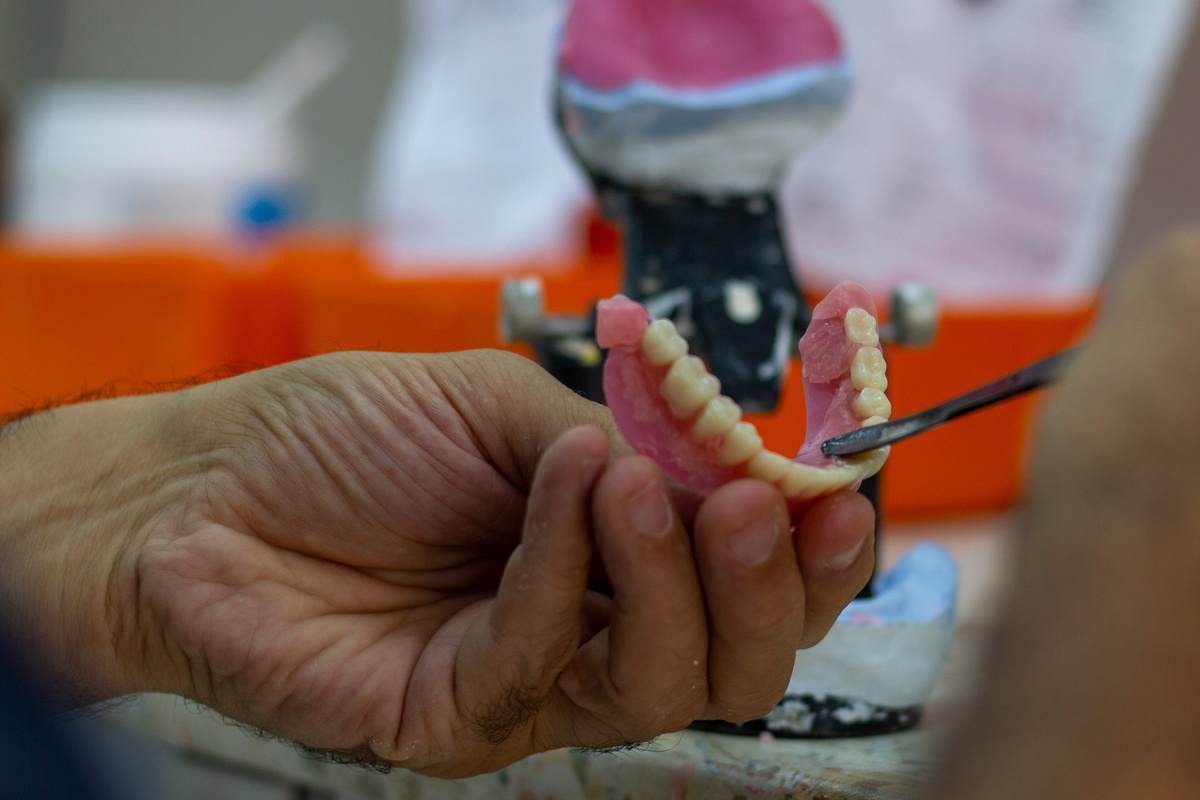
There is a particular frustration that comes with dentures — one most wearers know well. You did everything right. You got fitted, adjusted, re-lined. And still, something is off: a shift when you chew, a sore spot that won’t quit, or a smile that looks less like yours with every passing year. The truth is, dentures are not a permanent solution, and for many patients, the signs that they have run their course show up gradually — and then all at once.
At Brightworks Dentistry in Dunwoody, GA, we work with patients who arrive having spent years managing dentures, only to discover that a better option has been available the whole time. Full mouth implants replace the roots as well as the teeth, addressing the structural problems that dentures simply cannot. Knowing the signs that it is time to make the transition can save years of discomfort and protect the health of your jaw.
What Happens to Your Jaw Over Time With Dentures
When teeth are lost, the jawbone beneath them begins to shrink. This is because bone tissue needs the stimulation of tooth roots to maintain its density. Dentures rest on the surface of the gum and apply pressure to the ridge below — but that kind of pressure does not replicate what a root provides. Research published in the National Library of Medicine via NIH confirms that jaws with implant-supported prostheses show measurably less bone loss than those wearing conventional dentures, and that implant-supported prostheses have a bone-preserving effect that conventional dentures cannot replicate.
This bone loss — called resorption — is the core reason dentures stop fitting over time. As the ridge shrinks, the shape of the mouth changes. The denture that fit well at delivery may feel unstable within a few years, and that instability typically accelerates. Relining and refitting can buy time, but they do not address the underlying cause.
Signs Your Dentures Are No Longer Working
Some of the signals are obvious; others are easy to dismiss as normal. Recognizing them clearly is the first step toward making an informed decision.
The most common signs include persistent slipping and movement during eating or speaking, sore spots or chronic irritation along the gum ridge, difficulty chewing foods you once ate comfortably, and changes in your facial appearance — particularly around the lower third of the face — due to jawbone loss. Dentures that once needed adhesive only occasionally may begin to require it constantly, which is a reliable signal that the fit has changed significantly.
Beyond comfort, there are functional signs worth noting as well. If you have begun avoiding certain foods, changing how you speak in public, or pulling back from social situations because of concerns about your denture slipping, these are meaningful quality-of-life signals — not just inconveniences.
Why Full Mouth Implants Address What Dentures Cannot
Implants work differently at a biological level. A titanium post is placed into the jawbone, where it integrates with the bone over time in a process called osseointegration. That fusion means the implant actually stimulates the bone the way a natural root does, halting the resorption cycle. The restoration attached to the implant does not rest on the gum — it is anchored, which means no movement, no adhesive, and no ongoing loss of fit as the jaw changes.
Restorative dentistry has advanced significantly in what implant-supported full arch restorations can accomplish. For patients who are candidates, options like All-on-4 allow an entire arch to be supported by as few as four strategically placed implants — which means many patients who assumed they had lost too much bone for implants may still be candidates. A thorough evaluation is the only way to know for certain.
Make the Transition With Brightworks Dentistry Today
At Brightworks Dentistry, Dr. Patrice Robbins and Dr. Preston Shurley approach full mouth restoration as a comprehensive process — not a quick fix. Dr. Robbins trained at Spear Education in Scottsdale and brings a meticulous cosmetic eye to every restorative plan, while Dr. Shurley completed an Advanced General Dentistry Residency and brings a precision-driven approach to complex cases. Together, they evaluate each patient’s bone volume, health history, and goals before recommending any course of treatment. Visit our meet the doctors page to learn more about their backgrounds and approach.
If your dentures have been causing problems — or if you have simply wondered whether something better is available — the answer is worth exploring. Contact our team to schedule a consultation at our Dunwoody office and find out whether full mouth implants are the right next step for you.